IsraHCI2014 – call for papers
Posted by Tal Oron-Gilad in News on October 7, 2013

IsraelDefense Conference on Unmanned Vehicles in Complex Environments (UVID 2013)
Posted by Tal Oron-Gilad in Military & Law Enforcement Applications, News, UAV on September 15, 2013
UVID International conference held on 10/10/2013.
Our paper “Is More Information Better? How Dismounted Soldiers Use Video Feed From Unmanned Vehicles: Attention Allocation and Information Extraction Considerations” won the best paper award for research articles in the area of unmanned systems and human factors. The award ceramony will take place at the conference.

Award ceramony with Alon Unger, the conference chair, Ophir Shoham, IMOD, and Prof. Daniel Weiss

Dr. Oron-Gilad presenting at the UVID conference

IsraelDefense Conference on Unmanned Vehicles in Complex Environments (UVID 2013)
Conference program can be seen at the following link:
Exploring the Effects of Driving Experience on Hazard Awareness and Risk Perception – a new publication
Posted by Tal Oron-Gilad in driving skills, hazard perception, News, Transportation & Safety on July 28, 2013
This is a “heavy” article co authored by Avinoam Borowsky – it summorizes in one study all the methodologies that we have used in the past to assess hazard perception and risk, and its power is in this overall view.
it portrays the use of three methodologies of assesment for hazard awareness and risk perception in a single study:
- Real-Time Hazard Identification,
- Hazard Classification
- Rating Tasks
Three level of experience/expertise groups were used:
- taxi drivers, who have some unique charaterisitcs
- experienced drivers (more than 7 years of driving experience)
- Young novice drivers (with less than 3 months of driving experience)
Accepted for publication July 2013. Please cite as: Borowsky, A., Oron-Gilad, T., Exploring the Effects of Driving Experience on Hazard Awareness and Risk Perception via Real-Time Hazard Identification, Hazard Classification, and Rating Tasks, Accident Analysis and Prevention (2013), http://dx.doi.org/10.1016/j.aap.2013.07.008
Abstract
This study investigated the effects of driving experience on hazard awareness and risk perception skills. These topics have previously been investigated separately, yet a novel approach is suggested where hazard awareness and risk perception are examined concurrently. Young, newly qualified drivers, experienced drivers, and a group of commercial drivers, namely, taxi drivers performed three consecutive tasks: (1) observed 10 short movies of real-world driving situations and were asked to press a button each time they identified a hazardous situation; (2) observed one of three possible sub-sets of 8 movies (out of the 10 they have seen earlier) for the second time, and were asked to categorize them into an arbitrary number of clusters according to the similarity in their hazardous situation; and (3) observed the same sub-set for a third time and following each movie were asked to rate its level of hazardousness. The first task is considered a real-time identification task while the other two are performed using hindsight. During it participants’ eye movements were recorded. Results showed that taxi drivers were more sensitive to hidden hazards than the other driver groups and that young-novices were the least sensitive. Young-novice drivers also relied heavily on materialized hazards in their categorization structure. In addition, it emerged that risk perception was derived from two major components: the likelihood of a crash and the severity of its outcome. Yet, the outcome was rarely considered under time pressure (i.e., in real-time hazard identification tasks). Using hindsight, when drivers were provided with the opportunity to rate the movies’ hazardousness more freely (rating task) they considered both components. Otherwise, in the categorization task, they usually chose the severity of the crash outcome as their dominant criterion. Theoretical and practical implications are discussed.
Here is just one example of the manipulation used in the classification task, where we used common still images and one varied exemplar, to asses whether this manipulation changed participants classification.

Representative photos of the seven common movies for Sets 1-3, as they appear in Borowsky and Oron-Gilad (2013)

Representative photos of the varied exemplar for Sets 1-3, as they appear in Borowsky and Oron-Gilad (2013)
Child-pedestrians’ hazard perception abilities – a new publication in TRF
Posted by Tal Oron-Gilad in children, hazard perception, pedestrians, Transportation & Safety on July 7, 2013
Our new publication “Towards understanding child-pedestrians’ hazard perception abilities in a mixed reality dynamic environment” co-authored by Anat Meir and Yisrael Parmet is now available on Transportation Research part F.
This is our first published study on child pedestrians where we utilized our Dome projection facility.
See also a link to our video about the dome pedestrian simulator facility.
Abstract
Child-pedestrians, especially those in the age range of 5–9-years, are amongst the most vulnerable road users. These youngsters are highly represented in fatal and severe injury road crashes, despite relatively low levels of exposure to traffic. The present research investigated child and adult pedestrians’ perception of hazards utilizing a crossing decision task. Twenty-one adults (20–27 years-old) and twenty-five young-children (eight 7–9-year olds,five 9–10-year-olds and twelve 10–13-year-olds) were requested to observe traffic scene scenarios presented in a mixed reality dynamic environment simulating a typical Israeli city from a pedestrian’s perspective, and to press a response button whenever they assumed it was safe to cross. Results have shown that as pedestrians’ age and experience level increased their attentiveness towards potential hazards increases and their ability to anticipate upcoming events while engaging in a road-crossing task was enhanced. Furthermore, both the 9–10-year-olds and the 10–13-year-olds presented a less decisive performance compared to both the experienced-adult pedestrians and the 7–9-year-olds. Understanding child-pedestrians’ shortcomings in evaluating traffic situations may contribute to the effort of producing intervention techniques which may increase their attentiveness towards potential hazards and pave the way for reducing their over-involvement in road crashes. Implications for training novice road users will be discussed.
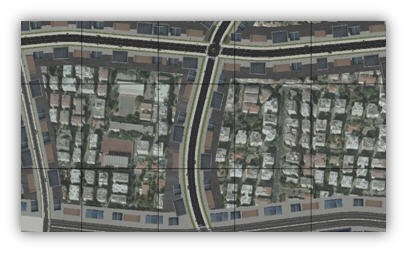
Our 3-D environment was specifically designed (B-design) for walking road users, as it provides high level of detail necessary for a walking person (i.e., not the entire urban model is built, the emphasis is on the façade). Using a 180 degrees large dome allows the feeling of immersion.

Eye tracking
A sample of a crossing scenario eye tracking pattern of a young pedestrian can be seen in the following video. Note the amount of time that the child spend viewing the cross walk itself rather than the road. My Ph.D student Hagai Tapiro is responsible for the production of this video.
Formation and Evaluation of Act and Anticipate Hazard Perception Training (AAHPT) intervention for young-novice drivers
Posted by Tal Oron-Gilad in News on May 2, 2013
Our most recent publication with regard to training young novice drivers on hazard perception co-authored with two of my former Ph.D. students Anat Meir and Avinoam Borowsky. Here we describe the foundations of the AAHPT intervention, as well as an assesment of its impact based on computerized hazard perception test.
To appear shortly in Traffic Injury Prevention.
Abstract
Objective: Young-novice drivers’ poor hazard perception (HP) skills are a prominent cause for their over-involvement in traffic crashes. HP, the ability to read the road and anticipate forthcoming events, is receptive to training. This study explored the formation and evaluation of a new HP training intervention – the Act and Anticipate Hazard Perception Training (AAHPT), which is based upon exposing young-novice drivers to a vast array of actual traffic hazards, aiming to enhance their ability to anticipate potential hazards during testing. Method: Forty young-novices underwent one of three AAHPT intervention modes (‘Active’, ‘Instructional’ or ‘Hybrid’) or a control group. ‘Active’ members observed video-based traffic-scenes and were asked to press a response button each time they detected a hazard. ‘Instructional’ members underwent a tutorial which included both written material and video-based examples regarding HP. ‘Hybrid’ members received a condensed theoretical component followed by a succinct ‘Active’ component. Control was presented with a road safety tutorial. Approximately one week later, participants performed a hazard perception test (HPT), during which they observed other movies and pressed a response button each time they detected a hazard. Twenty one experienced drivers also performed the HPT and served as a gold standard for comparison. Results: Overall, the ‘Active’ and the ‘Hybrid’ modes were more aware of potential hazards relative to the control. Conclusions: Inclusion of an active-practical component generates an effective intervention. Using several evaluation measurements aids performance assessment process. Advantages of each of the training methodologies are discussed.
Keywords: skill, training, experience, hazard perception, novice drivers, response time
Participants in the Instructional based mode observed slides as the one shown here


