Archive for category News
“Coming soon to a conference near you” – presentations and posters for the summer and fall of 2012
Posted by Tal Oron-Gilad in News on May 24, 2012
This summer our team will be presenting at the ICTTP 2012.
- Anat Meir my Ph.D. student will be presenting work that we have conducted in the dome projection facility with children. The title of the presentation is “Hazard perception abilities among child-pedestrians in a Dome-settings Environment” on Wednesday, 29th of August 2012.

- Studies in hazard perception in driving focus mainly on paradigms where participants are asked to observe short video clips of traffic situations from a driver’s perspective and press a response button each time they identify a hazard (see Horswill & McKenna (2004) for a review). Typically, when using this type of paradigm, young-novice drivers identify fewer potential hazards than experienced drivers and they are also slower. However, some studies did not find differences in response time (see Borowsky, Shinar, & Oron-Gilad, (2010)for example).
- Based on our thorough experience in analyzing these type of events we have developed a two-step analysis methodology. Dr. Yisrael Parmet will discuss the advantage and use of Survival Analysis in analyzing response times in driving related hazard perception paradigms on Friday, 31st of August 2012.
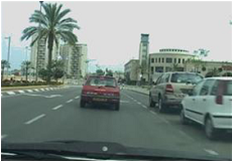

This fall our team will be presenting at HFES 2012 Annual meeting.
- “The use of a homogeneity measure to identify hazard perception abilities of novices and experienced drivers in a driving simulator” Omri Yona, Avinoam Borowsky, Tal Oron-Gilad and Yisrael Parmet
- Comparisons between young-novice and experienced drivers are beneficial for the development of both testing and training methodologies for young-novice drivers. Simulators are essential tools of driver assessment especially for novices. One way to look at the differences between driver groups is by examination of performance with regard to specific events. In addition, overall examination of performance across scenarios is important as it shows general patterns of behavior rather than specific ones. The common method to do so is by looking at the average of certain driving related measures or their variability. Using data derived from two hazard perception test (HPT) experiments in a driving simulator, we demonstrate how the use of a group homogeneity measure is more sensitive than the former two. Altogether, we demonstrate that consistently and regardless of road environment, experienced drivers manage their speed in a more homogenous way while novices act as inconsistent individuals.
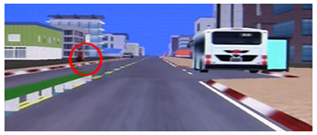

- “The Costs and Benefits of the “On-Thigh Vibrotactile Alerting System for the Cockpit” in High-Workload Environment” Yael Salzer and Tal Oron-Gilad
- In the cockpit, an overloaded working environment, performance is prone to break down. Conveying crucial information through the tactile modality, which requires little to no additional effort, has been previously examined as means to improve performance and safety. Previously, we demonstrated the ability of the on-thigh vibrotactile alerting display to convey directional cues in the vertical plane. We hypothesized that tactile directional alerting cues would be beneficial in a visually loaded multi tasking environment. Two tasks were introduced simultaneously: a directional task where participants respond to directional cues (visual, tactile, or combination of both), and a memory recall task where participants identify, count and recall objects embedded in flight movies. Response time, accuracy and subjective workload were evaluated. Performance in the memory recall task and subjective workload were in favor of the combined tactile & visual configuration. No performance difference was found between visual and tactile & visual in the directional task. We concluded that the redundant tactile & visual configuration may allow operators to choose a strategy in which perceptual and cognitive resources are better utilized.

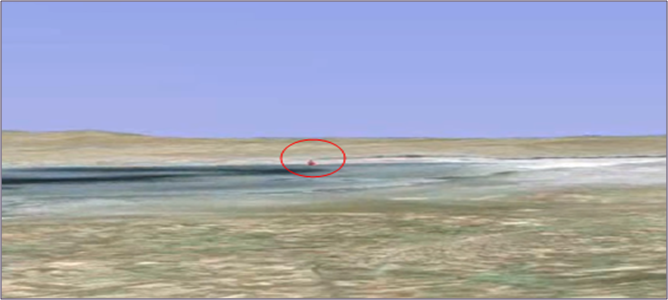
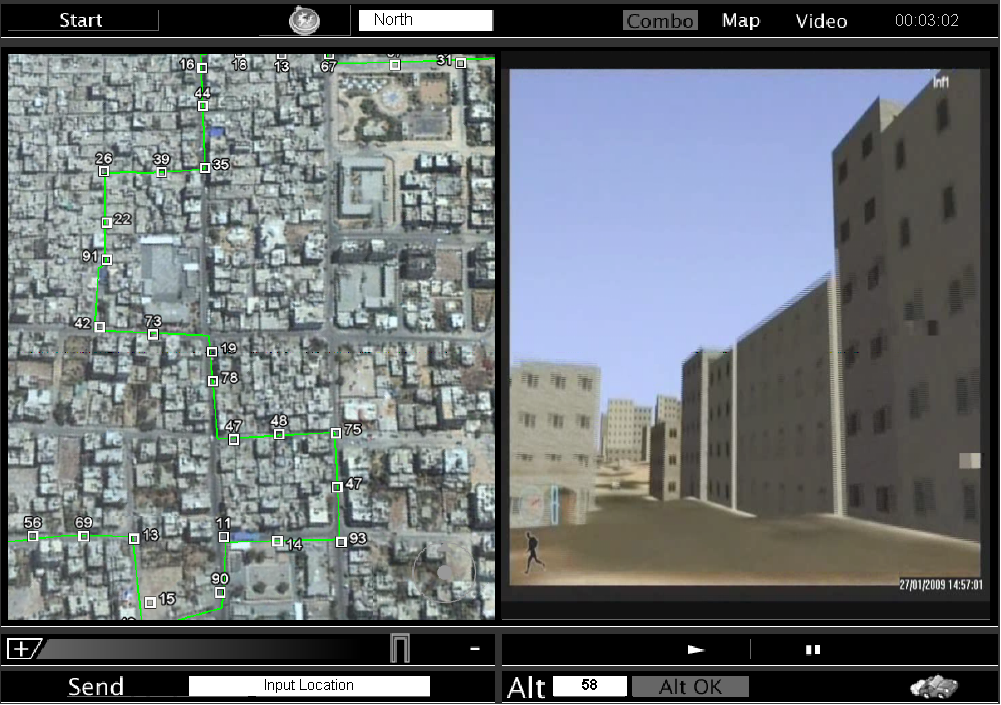
- “Display type effects in military operational tasks using Unmanned Vehicle (UV) video images: comparison between color and B/W video feeds” Yaniv Minkov, Ronny Ophir-Arbelle and Tal Oron-Gilad
- The increased use of unmanned vehicles (UVs) in military environments requires development of guidelines to enable maximal compatibility between those technologies and users’ needs. Specifically, the way video feeds are delivered to dismounted soldiers may affect the utility of such information. This work follows previous studies on the type (e.g., size) of displays required by dismounted soldiers to process video feed from UVs in a variety of operational situations. Sixteen former infantry soldiers with no experience using UV video feed participated. Three display types were examined using color or B/W video feeds and three different operational tasks (identification, orientation and movement detection). Performance and subjective data were collected. Results showed an effect for display type only with regard to response time. Feed color and display type interacted. The 12″ Tablet black and white feeds produced the shortest responses.



Tenured/tenure-track openings in HF/E at BGU
Posted by Tal Oron-Gilad in News on March 16, 2011
The Dept. of Industrial Engineering and Management at BGU has two immediate tenured/tenure-track openings for scholars with proven track record in HF/E (Human Factors/Ergonomics). The ideal candidate should have a broad perspective on applications of Human-System Integration. Domain of expertise is flexible though health care or transportation-related systems would be an advantage. Candidates will be expected to engage in new and on-going funded research and to develop externally funded research program. Candidates must be able to teach undergraduate and graduate courses in HFE and related topics, as well as, supervise graduate students.
Candidates must possess an earned doctorate in HFE or a related discipline, with demonstrated record of academic scholarship and a commitment to teaching excellence. Knowledge of Hebrew is desirable but not a pre-requisite.
Details about these two positions can be obtained directly from me (orontal@bgu.ac.il) or Prof. David Shinar (Shinar@bgu.ac.il).
Older drivers overlook streetside pedestrians
Posted by Tal Oron-Gilad in News, Transportation & Safety on March 9, 2011
Check this out, we were cited in the media.
Mentioning of our recent manuscript on hazard perception among elderly drivers appears now in the US media:
http://www.latimes.com/health/boostershots/la-heb-older-drivers-030711,0,5665036.story?track=rss
To view the full article:
Bromberg, S., Oron-Gilad T., Ronen, A., Borowsky, A. and Parmet Y. (in press), The perception of pedestrians from the perspective of elderly-Experienced and Experienced drivers Accident Analysis and Prevention, 2010.
http://dx.doi.org/10.1016/j.aap.2010.12.028
See more in:
Utilizing Hand Gesture Interaction in Standard PC-based Interfaces
Posted by Tal Oron-Gilad in Gesture interaction, Gesture vocabulary, human factors engineering, News on February 27, 2011
- This work was conducted by my former graduate student Jenny Grinberg. It focused on how a gesture vocabulary should be applied when gestures are being used in standard window interfaces (Windows, files and folders). We are currently in process of writing up the publication.
- Interface technologies have only started to adopt hand gestures and most human-computer controls still require physical devices such as keyboard or mouse.
- To evaluate the influence of keyboard interaction, gestures and combined interaction on user experience an existing hand gesture recognition system (developed by Stern & Efros, 2005) was integrated into a common Windows environment.
- Two experiments varied in the way the Gesture Vocabulary (GV) was introduced; bulk (Experiment 1) or gradual learning (Experiment 2).
- Results indicated that all gestures used in the GV were simple and could be executed within a relatively short learning period.
- Nevertheless, keyboard interaction remained the most efficient, least demanding, and most preferred way.
- Performance and subjective ratings of gestures and combined interaction were significantly different from those of the keyboard, but not from each other.
Interesting differences among genders emerged:
- Combined interaction was preferred over gestures-alone among women.
- With regard to the GV introduction, experiment one revealed that performance time and error rate with gestures were significantly higher for females than for males. However, gradual introduction of gestures (experiment two) improved females’ subjective satisfaction, decreased their performance time, and did not worsen error rate. For males, no such differences were found.
- Men and women related differently to the gesture displays and women perceived textual labels as more useful.
Here is a screen shot of the application consisting of a standard window which enables to perform the most commonly used commands with folders and files (e.g., open a folder, move the cursor to the right folder, etc.) via hand gestures or via keyboard. To the right is the gesture feedback window (which is part of the gesture recognition system developed by Stern & Efros, 2005).

- To the right, the visual display as captured by the gesture recognition camera
- To the left, the main task window containing files in folders
- at the bottom of the screen are various parameters regarding the hand’s position and a label with the name of the current command
Gesture Vocabulary (GV) design.
Nine dynamic gestures were defined with one of them as the start/end position. The other eight represented the most commonly used commands in file management navigation processes; right, left, up and down, entering and exiting a folder, and copy/paste commands.
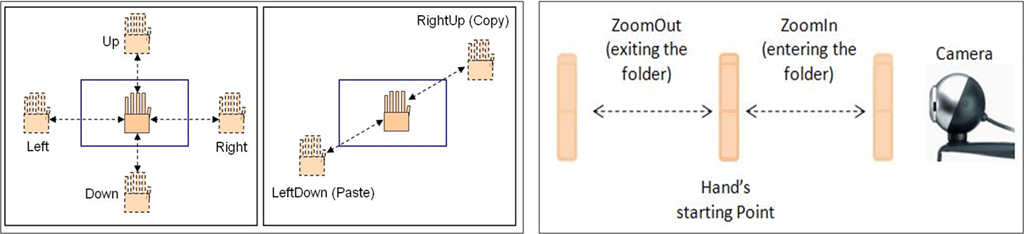
Here is a video demo of the various gestures used.
Initial findings were reported in Grinberg J. and Oron-Gilad T., Utilizing Hand-Gesture Interaction in Standard PC Based Interfaces, proceeding of the International Ergonomica Association IEA 2009, Bejing, China.
VibroTactile “On-Thigh” Alerting System in The Cockpit
Posted by Tal Oron-Gilad in News, Tactile & Multimodal displays on January 23, 2011
Here is a new study that we have conducted on applying vibrotactile alerts on the thigh of a seated operator. The thigh is a novel placement that has not been used previously in a similar way.
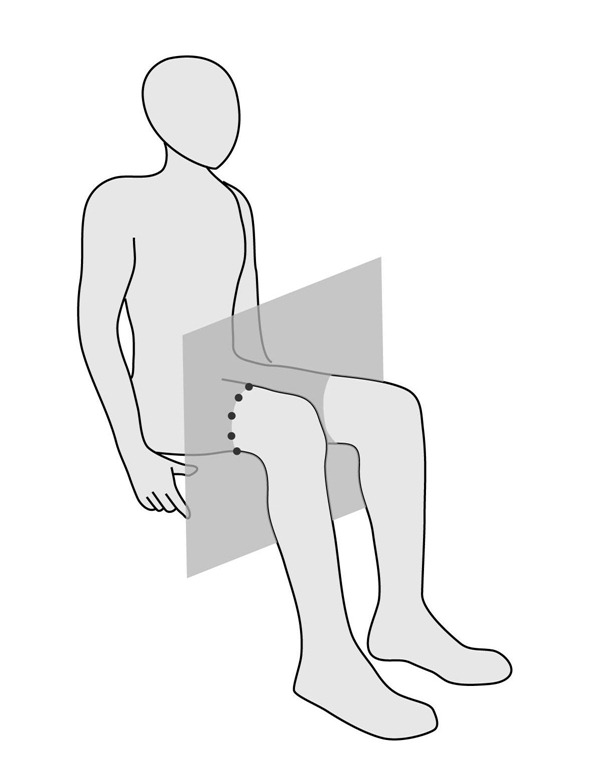
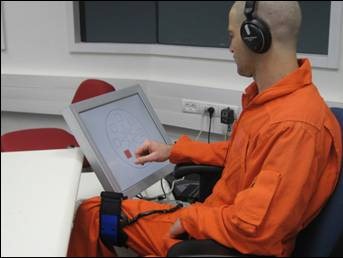
To read more see: Salzer, Y., Oron-Gilad, T., Ronen, A., and Parmet, Y. (2011), VibroTactile “On-Thigh” Alerting System in The Cockpit, Human Factors. available online at :http://hfs.sagepub.com/content/early/2011/04/06/0018720811403139
Background: Alerts in the cockpit must be robust, difficult to ignore and easily recognized. Tactile alerts can provide means to direct the pilot’s attention in the already visual-auditory overloaded cockpit environment. Objective: This research examined the thigh as a placement for vibrotactile display in the cockpit. Here we: a) report initial findings concerning the loci and properties of the display, b) evaluate the added value of tactile cueing with respect to the existing audio-visual alerting system, and c) address the issue of tactile orienting; whether the cue should display ‘flight’ or ‘fight’ orienting. The tactor display prototype was developed by a joint venture of Israel Aerospace Industries (IAI), Lahav division and the Ben Gurion University of the Negev (patent pending 11/968,405). Methods: Vibrotactile display mounted on the thigh provided directional cues in the vertical plane. Two vibrotactile display modes (eight and four tactors) and two response modes (compatible, i.e. flight (away from hazard) and inverse, i.e. fight (toward hazard)) were evaluated. Results: Vertical directional orienting can be achieved by a vibrotactile display assembled on the thigh. Four tactors display mode and the compatible response mode produced more accurate results. Conclusion: Tactile cues can provide directional orienting in the vertical plane. The benefit of adding compatible tactile cues with the visual and auditory cues alone has yet to be reinforced. Nevertheless, flight mode, i.e. directing towards escape from hazardous situations, was preferred. Application: Potential applications include providing directional collision alerts within the vertical plane, assisting pilot’s elevation control, or navigation.
-
You are currently browsing the archives for the News category.

 Human Factors Engineering