Child Pedestrian Crossing Study – Trailer
Posted by Tal Oron-Gilad in Transportation & Safety on May 1, 2011
- Pedestrian road crashes cause death, injury and disability among children. Five to nine year old children endure ~four times the injury rate of adults, in spite of their lower exposure to traffic.
- Practical training can lead to improvements in children’s crossing skills, e.g., the ability to make roadside timing judgments (Demetre et al., 1992), plan safe routes (Thomson et al., 1992) and cross safely at junctions (Rothengatter, 1984).
A first step in developing a training program is to form understanding of children traffic behavior patterns, e.g., when and where do children cross? What are they looking out for before crossing? etc.
Comparing adults and children provides a depiction of what elements in the traffic environment are crucial for the road crossing task.
- In the present study, children and adults participate in a two-phase experiment. They observe typical urban scenarios from the point of view of pedestrians and are asked to:
- Describe the features that they perceive as relevant for crossing the road safely, i.e., the conceptual model each group has.
- Press a button or ‘step off a curb’ each time they think it is safe to cross.
- Eye movements are recorded using a helmet mounted tracker, as shown in the Trailer.
References
Demetre, J.D. & S. Gaffin, S. (1994). The salience of occluding vehicles to child pedestrians, British Journal of Educational Psychology, 64, 243–251.
Rothengatter, J.A. (1984). A behavioral approach to improving traffic behaviour of young children. Ergonomics 27 (1984), pp. 147–160.
Thomson, J.A., Tolmie, A., Foot, H.C. & McLaren, B. (1996). Child Development and the Aims of Road Safety Education. Road Safety Research Report No. 1. London: HMSO.
Inexperienced drivers training program – Trailer
Posted by Tal Oron-Gilad in driving skills, human factors engineering, in-vehicle, Transportation & Safety on April 20, 2011
Driving is a demanding task combining complex motor and cognitive skills. A typical driving task may include maneuvering among other vehicles, paying attention to various road users (e.g., drivers and pedestrians), and discerning static and dynamic road signs and obstacles). The total amount and rate of information presented to the driver is more than a human brain can handle at a given time. Thus, the road presents a vast array of accessible information, but drivers notice and attend only to a small fraction of it.
Recent evidence suggests that among all driving skills, only hazard awareness – the ability of drivers to read the road and identify hazardous situations –correlates with traffic crashes (e.g., Horswill and McKenna, 2004). Furthermore, McKenna et al. (2006) have shown that improving hazard awareness skills (via training to identify hazardous situations) resulted in a decrease in risk taking attitudes for novice drivers. These findings and others (e.g., Pradhan et al., 2009; Borowsky et al., 2010; Pollatsek et al., 2006; Deery, 1999) acknowledge that young-novice drivers might be less aware of potential hazards and risks embedded in a situation, and thus are more susceptible to taking risks while driving because of this lack of awareness.
References
Borowsky, A., Shinar, D., & Oron-Gilad, T. (2010). Age and skill differences in driving related hazard perception, Accident Analysis and Prevention, vol. 42, pp. 1240-1249.
Deery, H.A. (1999). Hazard and risk perception among young novice drivers. Journal of Safety Research, 30(4), 225-236.
Horswill, M. S., & McKenna, F. P. (2004). Drivers’ hazard perception ability: Situation awareness on the road. In S. Banbury and S. Tremblay (Eds.), A cognitive approach to situation awareness: Theory and application (pp. 155-175). Aldershot, United Kingdom: Ashgate.
McKenna, F. P., Horswill, M. S., & Alexander, J. L. (2006). Does anticipation training affect drivers’ risk taking? Journal of Experimental Psychology, 12, 1-10.
Pollatsek, A., Narayanaan, V., Pradhan, A., & Fisher, D. L. (2006). Using eye movements to evaluate a PC-based risk awareness and perception training program on a driving simulator. Human Factors, 48, 447–464.
Pradhan, A. K., Pollatsek, A., Knodler, M., & Fisher, D. L. (2009). Can younger drivers be trained to scan for information that will reduce their risk in roadway traffic scenarios that are hard to identify as hazardous? Ergonomics, 52, 657-673.
Tenured/tenure-track openings in HF/E at BGU
Posted by Tal Oron-Gilad in News on March 16, 2011
The Dept. of Industrial Engineering and Management at BGU has two immediate tenured/tenure-track openings for scholars with proven track record in HF/E (Human Factors/Ergonomics). The ideal candidate should have a broad perspective on applications of Human-System Integration. Domain of expertise is flexible though health care or transportation-related systems would be an advantage. Candidates will be expected to engage in new and on-going funded research and to develop externally funded research program. Candidates must be able to teach undergraduate and graduate courses in HFE and related topics, as well as, supervise graduate students.
Candidates must possess an earned doctorate in HFE or a related discipline, with demonstrated record of academic scholarship and a commitment to teaching excellence. Knowledge of Hebrew is desirable but not a pre-requisite.
Details about these two positions can be obtained directly from me (orontal@bgu.ac.il) or Prof. David Shinar (Shinar@bgu.ac.il).
Older drivers overlook streetside pedestrians
Posted by Tal Oron-Gilad in News, Transportation & Safety on March 9, 2011
Check this out, we were cited in the media.
Mentioning of our recent manuscript on hazard perception among elderly drivers appears now in the US media:
http://www.latimes.com/health/boostershots/la-heb-older-drivers-030711,0,5665036.story?track=rss
To view the full article:
Bromberg, S., Oron-Gilad T., Ronen, A., Borowsky, A. and Parmet Y. (in press), The perception of pedestrians from the perspective of elderly-Experienced and Experienced drivers Accident Analysis and Prevention, 2010.
http://dx.doi.org/10.1016/j.aap.2010.12.028
See more in:
Utilizing Hand Gesture Interaction in Standard PC-based Interfaces
Posted by Tal Oron-Gilad in Gesture interaction, Gesture vocabulary, human factors engineering, News on February 27, 2011
- This work was conducted by my former graduate student Jenny Grinberg. It focused on how a gesture vocabulary should be applied when gestures are being used in standard window interfaces (Windows, files and folders). We are currently in process of writing up the publication.
- Interface technologies have only started to adopt hand gestures and most human-computer controls still require physical devices such as keyboard or mouse.
- To evaluate the influence of keyboard interaction, gestures and combined interaction on user experience an existing hand gesture recognition system (developed by Stern & Efros, 2005) was integrated into a common Windows environment.
- Two experiments varied in the way the Gesture Vocabulary (GV) was introduced; bulk (Experiment 1) or gradual learning (Experiment 2).
- Results indicated that all gestures used in the GV were simple and could be executed within a relatively short learning period.
- Nevertheless, keyboard interaction remained the most efficient, least demanding, and most preferred way.
- Performance and subjective ratings of gestures and combined interaction were significantly different from those of the keyboard, but not from each other.
Interesting differences among genders emerged:
- Combined interaction was preferred over gestures-alone among women.
- With regard to the GV introduction, experiment one revealed that performance time and error rate with gestures were significantly higher for females than for males. However, gradual introduction of gestures (experiment two) improved females’ subjective satisfaction, decreased their performance time, and did not worsen error rate. For males, no such differences were found.
- Men and women related differently to the gesture displays and women perceived textual labels as more useful.
Here is a screen shot of the application consisting of a standard window which enables to perform the most commonly used commands with folders and files (e.g., open a folder, move the cursor to the right folder, etc.) via hand gestures or via keyboard. To the right is the gesture feedback window (which is part of the gesture recognition system developed by Stern & Efros, 2005).

- To the right, the visual display as captured by the gesture recognition camera
- To the left, the main task window containing files in folders
- at the bottom of the screen are various parameters regarding the hand’s position and a label with the name of the current command
Gesture Vocabulary (GV) design.
Nine dynamic gestures were defined with one of them as the start/end position. The other eight represented the most commonly used commands in file management navigation processes; right, left, up and down, entering and exiting a folder, and copy/paste commands.
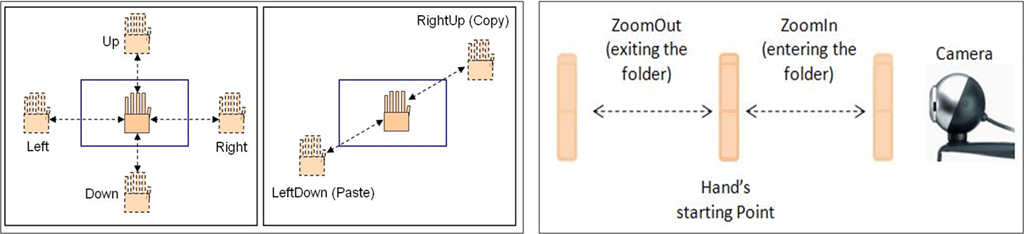
Here is a video demo of the various gestures used.
Initial findings were reported in Grinberg J. and Oron-Gilad T., Utilizing Hand-Gesture Interaction in Standard PC Based Interfaces, proceeding of the International Ergonomica Association IEA 2009, Bejing, China.


