Is more information better? How dismounted soldiers utilize video feed from unmanned vehicles – attention allocation and information extraction considerations
Posted by Tal Oron-Gilad in Military & Law Enforcement Applications, UAV on February 22, 2012
Ronny Ophir-Arbelle, Tal Oron-Gilad, Avinoam Borowsky and Yisrael Parmet
Background: Operational tactics in urban areas are often aided by information from unmanned aerial vehicles (UAVs). A major challenge for dismounted soldiers, particularity in urban environments is to understand the conflict area in general and particularly from the UAV feed. The UAV feed is usually used to enhance soldiers’ situation awareness abilities but less for identifying specific elements. Objective: A possible way to further enhance soldiers’ abilities is to provide them with multiple sources of information (e.g., aerial and ground views). This study examined the benefits of presenting video feed from unmanned aerial and ground vehicles (UAV/UGV) in a combined interface, relative to presenting aerial feed alone. Method: Thirty former infantry soldiers with no experience in operating unmanned vehicles participated. Objective performance, subjective evaluations and eye tracking patterns were examined, in two separate scenarios. Results: In Scenario one performance scores in both Identification and Orientation tasks were superior in the combined configuration. In Scenario two performance scores in the Identification tasks were improved and the addition of the UGV feed did not harm performance in the Orientation task. Eye movement scanning patterns reinforced that both UAV and UGV feeds were used for the mission. Conclusion: The combined configuration generated consistent benefits with regard to the Identification tasks, perceived mental demand, and reduction of false reports without having any apparent cost on participants. Application: Ground views may provide additional support to dismounted soldiers.
The full article appears in the Journal of Cognitive Ergonomics and Decision Making.
Here is a sample video feed of the eye scanning pattern of a single participant derived from Scenario 2. Note how the participant utilizes the C2 map (to the right) and both video sources.
Passive Operators\Information Consumers differ from operators and need special attention and interfaces to support their operational missions.
Here are some of the differences to consider:
- Operational environment does not necessarily resemble the one of the unmanned system’s operator
- Experience and expertise is different
- Dismounted soldiers are limited in the weight and size of devices they can carry
- Missions are diverse and often stressful
- Information is provided from multiple sources (unmanned systems, commanders, others)
- Multiple video feeds from various sources – the passive operator may not be aware or familiar with each system and its characteristics – operators are supposed to know their systems’ limitations well
- Communication chains with active operators are indirect or blocked
We have been continuously working on developing interfaces for “passive” operators. See also Scalable interfaces for dismounted soldiers–displaying multiple video feed sources simultaneously
Here are two images from the current study: one of the interface and one of the scanning patterns of a sample participant. From the scanning pattern it is notable that the stronger routes are between the UAV and the map and the UAV and the UGV feed.

Display layout for the “is more information better” (2012) study

Sample eye scanning patterns for the “Is more information” (2012) study
Perceptions of electronic navigation displays
Posted by Tal Oron-Gilad in Affective Design, in-vehicle on December 1, 2011
Abstract
This study evaluated aesthetics and usability of in-vehicle electronic navigation maps. Experiment 1 examined map displays that varied in the amount of information presented, abstraction level, graphic/color style, and the existence of landmarks in both urban and rural environments using objective and subjective measures. Twenty participants performed navigation/localization tasks using various map configurations while driving a driving simulator and completed usability and aesthetic questionnaires (using the Perceived aesthetics and usability questionnaire items for maps). The minimal detail map produced better performances and higher usability and aesthetic ratings when using maps with no landmarks. Adding information in the form of landmarks was found advantageous compared to additional textual information. Abstractions were most advantageous when combined with minimal amount of detail. Moderate abstractions were sufficient for obtaining the desired benefits when more details were present. The graphic/color style affected subjective perceptions. Overall, high correlations were found for the perceived aesthetics and usability scales, however, low correlations were found between actual usability (i.e., performance) and perceived usability pointing to the importance of using both objective and subjective usability measures. Experiment 2 examined how maps varying in their aesthetic level (aesthetic versus non-aesthetic), different color arrangements, and 2D versus 3D landmarks affect subjective and objective measures. Participants distinguished between usability and aesthetic perceptions and usability perceptions were less affected by aesthetics when the aesthetic level of the maps was low. Color arrangement did not affect the measures examined. Both 2D and 3D landmarks were found to be aesthetic and usable. We conclude this paper with guidelines for designing in-vehicle navigation map displays.
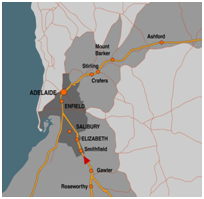
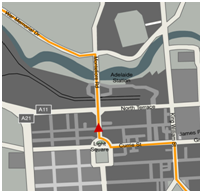
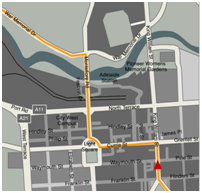
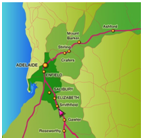
Here are some map images:
Examples of maps with more (right maps) and less (left maps) information for the rural (upper row) and urban (bottom row) settings
 |
 |
 |
 |
Rural maps showing examples of the three graphic styles used in Experiment 1 (a-c) and an example of the additional non-aesthetic color palette used in Experiment 2
(a) Contemporary Blue |
(b) Traditional Gray |
(c) Realistic Green
|
(d) Non-aesthetic color combination
|

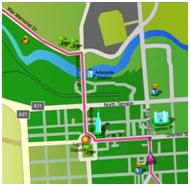
Examples of landmarks in an urban map
| No landmarks
|
Few landmarks – close to the route
|
Many landmarks
|


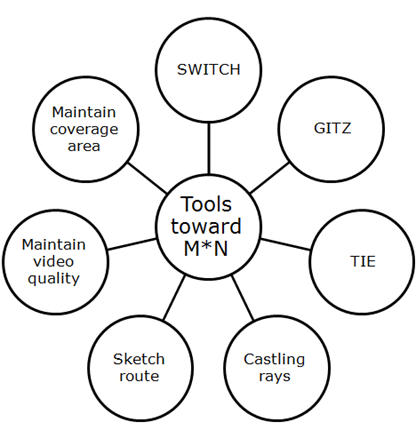
Tools and Techniques to support operators in MOMU (Multiple Operator Multiple UAV) environments
Posted by Tal Oron-Gilad in human factors engineering, Military & Law Enforcement Applications, MOMU, robotics, UAV on December 1, 2011
The ‘RICH’ (Rapid Immersion tools/techniques for Coordination and Hand-offs) research project is a US-Israel collaboration. The project aims to research, design and develop tools, techniques and procedures to aid operators in MOMU environments; to facilitate task switching and/or coordinate with other operators all for the benefit of improving overall mission performance.The Israeli partners on this task are Jacob Silbiger from Synergy Integration, Lt. Col. Michal Rottem-Hovev from the IAF, and Drs. Tal Oron-Gilad and Talya Porat from the Dept. of Industrial Engineering and Management. The US parents are Jay Shively, Lisa Fern (Human Systems Integration Group Leader, Aeroflightdynamics Directorate, US Army Research Development and Engineering Command (AMRDEC)), and Dr. Mark Draper (USAFRL). RICH is part of the US/Israel MOA (mutual operation agreement) on Rotorcraft Aeromechanics & Man/Machine Integration Technology.
Here I describe in brief the goals of the Israeli team and some of the tools developed.
Motivation: Multiple operators controlling multiple unmanned aerial vehicles (MOMU) can be an efficient operational setup for reconnaissance and surveillance missions. However, it dictates switching and coordination among operators. Efficient switching is time-critical and cognitively demanding, thus vitally affecting mission accomplishment. As such, tools and techniques (T&Ts) to facilitate switching and coordination among operators are required. Furthermore, development of metrics and test-scenarios becomes essential to evaluate, refine, and adjust T&Ts to the specifics of the operational environment.
Tools: Tools can be divided into two categories: 1) tools that facilitate ‘quick setup’, i.e., aimed to ease the way of the operator into a new mission or area of operation; and 2) tools that facilitate on-going missions where acquiring new UAVs, delegating, or switching is necessary to complete the tasks at hand. The Israeli team focused primarily on tools of the second type. Some “successful” tools have been the Castling rays (see CHI paper for detail), the TIE/coupling tool, and the Maintain coverage area.
Several outcomes of this effort have been presented and appear in the following conference proceedings.
- Tal Oron-Gilad, Talya Porat, Lisa Fern, Mark Draper, Jacon Silbiger, Michal Rottem Hovev and Jay Shively. Tools and Techniques for MOMU (Multiple Operator Multiple UAV) Environments;” , Human Factors and Ergonomics Society’s 55th Annual Meeting.
- Tal Oron-Gilad, Talya Porat, Jacob Silbiger, and Michal Rottem-Hovev. Decision Support Tools and Layouts for MOMU (multiple operator multiple UAV) Environments. ISAP Dayton OH, May 2-May 5, 2011.
- Talya Porat, Tal Oron-Gilad, Jacob Silbiger, and Michal Rottem-Hovev. Switch and Deliver: Decision Support Tools for MOMV (Multiple Operator Multiple Video feed) Environments, COGSIMA, Miami, FL. Feb. 22-24, 2011.
- Porat T., Oron-Gilad T., Silbiger J, and Hovev M. ‘Castling Rays’ a Decision Support Tool for UAV-Switching Tasks. CHI EA ’10 Proceedings of the 28th of the international conference extended abstracts on Human factors in computing systems.
Child Pedestrian Crossing Study – a few updates
Posted by Tal Oron-Gilad in human factors engineering, Transportation & Safety on September 1, 2011
We have just completed this study. Analysis of results and full report are being prepared.
The objective of the research is to lay the foundations for examining whether training child-pedestrians’ HP skills while crossing a road may improve their ability to perceive potentially hazardous situations and to predict hazards prior to their materialization.
- A first step in developing a training program is to form understanding of child-pedestrians’ traffic behavior patterns. Comparing adults and children provides a depiction of what elements in the traffic environment are crucial for the road-crossing task.
- In the present study, children and adults participant in a two-phase experiment. They observe typical urban scenarios (see Figure 1) from a pedestrian’s point of view (see Figure 2) and a required to: (1) Press a response button each time they feel it is safe to cross. (2) Describe the features that they perceive as relevant for a safe road-crossing decision, i.e., the conceptual model each group of pedestrians has. Participants’ eye-movements were recorded throughout the experiment utilizing a helmet mounted tracker (Model H6-HS, Eyetrack 6000).
- To achieve this a three dimensional database of a prototypical Israeli city was built in cooperation with b.design (http://www.b-d.co.il/) , a leading provider of 3-D content. Cars, trees, billboards and various other urban elements were also designed uniquely for this environment. Using the VR-Vantage and VR-Forces different scenarios were developed to examine crossing behavior at various conditions.
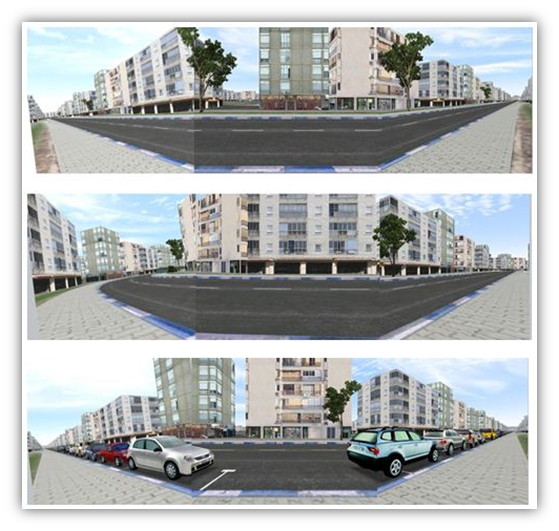
Figure 1. The generic city simulated environment presented in the Dome setting (it looks a bit awkward here because its intended to be projected on a dome screen). The Field of View is: (1) Unrestricted (above); (2) Partially obscured by the road’s curvature (middle); (3) Partially obscured by parked vehicles (below).
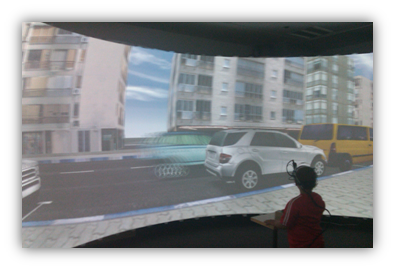
Figure 2. Simulated environment from a child-pedestrian’s point of view.
Perceptions of electronic navigation displays
Posted by Tal Oron-Gilad in Affective Design, in-vehicle, Transportation & Safety on August 15, 2011
Electronic navigation maps
- support drivers when travelling within unfamiliar areas
- need to support several tasks; visual search, location assessment, and complex integrative route planning
- are used while driving, when drivers should not take more than quick glances at them, it is essential that they do not impair driving safety.
- will become a necessity in future vehicle configurations, i.e., as vehicles become more semi-autonomous and drivers changre from active operators of the vehicle to passive monitors
The study
- examined different display formats to better support usability and aesthetic requirements.
- aimed to validate the results found by Lavie, Oron-Gilad and Meyer (2010).
- further examine additional design attributes – focusing on:
- graphic style
- landmarks and how landmarks affect aesthetic perceptions
- rural and urban road maps
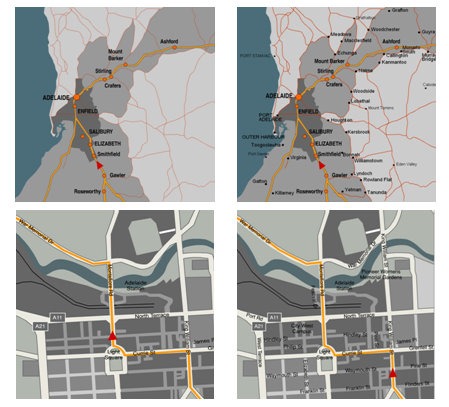
Figure 1. Examples of maps in a ‘Traditional elegant monochromatic’ graphic style, with more (right maps) and less (left maps) information for the rural (upper row) and urban (bottom row) settings.
Experiment 2 further examined maps with non-aesthetic graphic styles to see how that affects usability perception and actual use.

Figure 1. Examples of maps. Right: a ‘Realistic green’ graphic style, Left: an illustration of an ‘arbitrary’ color arrangement, i.e., the color coded areas do not correspond with the driver’s route.
To read more, look for:
Talia Lavie and Tal Oron-Gilad, Perception of navigation displays, to appear in Behaviour & Information Technology
Abstract
This study evaluated aesthetics and usability of in-vehicle electronic navigation maps. Experiment 1 examined map displays that varied in the amount of information presented, abstraction level, graphic/color style, and the existence of landmarks in both urban and rural environments using objective and subjective measures. Twenty participants performed navigation/localization tasks using avrious map configurations while driving a driving simulator and completed usability and aesthetic questionnaires. The minimal detail map produced better performances and higher usability and aesthetic ratings when using maps with no landmarks. Adding information in the form of landmarks was found advantageous compared to additional textual information. Abstractions were most advantageous when combined with minimal amount of detail. Moderate abstractions were sufficient for obtaining the desired benefits when more details were present. The graphic/color style affected subjective perceptions. Overall, high correlations were found for the perceived aesthetics and usability scales, however, low correlations were found between actual usability (i.e., performance) and perceived usability pointing to the importance of using both objective and subjective usability measures. Experiment 2 examined how maps varying in their aesthetic level (aesthetic versus non-aesthetic), different color arrangements, and 2D versus 3D landmarks affect subjective and objective measures. Participants distinguished between usability and aesthetic perceptions and usability perceptions were less affected by aesthetics when the aesthetic level of the maps was low. Color arrangement did not affect the measures examined. Both 2D and 3D landmarks were found to be aesthetic and usable. We conclude this paper with guidelines for designing in-vehicle navigation map displays.


