HFES 2015
Posted by Tal Oron-Gilad in Military & Law Enforcement Applications, Tactile & Multimodal displays on November 8, 2015
At the HFES Annual meeting we presented two studies related to interfaces for dismounted soldiers.
Tactile Interfaces for Dismounted Soldiers: User-perceptions on Content, Context and Loci
Nuphar Katzman, Tal Oron-Gilad, and Yael Salzer
Reviews of Human Factors and Ergonomics. 2015; 59:421-425. [Abstract] [PDF]
Interfaces for dismounted soldiers: examination of non-perfect visual and tactile alerts in a simulated hostile urban environment
Tal Oron-Gilad, Yisrael Parmet, and Daniel Benor
Reviews of Human Factors and Ergonomics. 2015; 59:145-149. [Abstract] [PDF]
IsraHCI – The Fourth Israeli Human-Computer Interaction Research Conference
Posted by Tal Oron-Gilad in News on September 4, 2015
IsraHCI – February 18, 2016
Call for submissions
Conference website: http://israhci.org
Facebook group: https://www.facebook.com/groups/IsraHCI/
LinkedIn group: http://www.linkedin.com/groups?gid=4698270
Important Dates
Submission Date: November 15, 2015.
Notification of Acceptance: December 7, 2015.
Conference: Feb 18th, Shenkar College of Engineering, Design, Art, Ramat-Gan
Topics of Interest – Topics include, but are not limited to:
Interactive artifacts and wearable computing
Ubiquitous and pervasive computing
Interaction models for children and the elderly
Social aspects of human-computer interaction
New interaction techniques, devices and interfaces
Mobile interaction
Tangible human-computer interaction
Human-robot interaction
Cognitive aspects of human-computer interaction
Evaluation methods for usability and user experience
Group and collaborative interactions
Interactive information visualization
User interaction in the car and in other high-stake environments
Design methods
The organizational and business context of computer interaction
Universal access and international interfaces
Specific issues that are relevant to Israel’s political situation and population
Augmented and virtual reality interfaces
Usability of privacy and security mechanisms
A retrospective look at the operator/UAS ratio and its implications
Posted by Tal Oron-Gilad in Military & Law Enforcement Applications, operational concepts, unmanned aerial systems on August 2, 2015
Come see us at the AUVSI conference November 2015 in Tel-Aviv.
Can child-pedestrians’ hazard perception skills be enhanced?
Posted by Tal Oron-Gilad in Hazard perception; Traffic crashes; Children; Educational intervention; Skills; Road crossing on August 2, 2015
Here is a fresh publication on Child pedestrians. We introduce here, for the first time, the Child-pedestrians Anticipate and Act Hazard Perception Training (CA2HPT), which is based on the same principles as our Act and Anticipate Hazard Perception Training (AAHPT) for young novice drivers.
Highlights
- Hazard perception (HP) is the ability to read the road and anticipate future events.
- 7–9-Year-olds’ HP skills were trained in a simulated dome projection environment.
- Training utilized a conceptually innovative approach taken from the driving HP domain.
- Trainees were found to be more aware of potential hazards related to restricted field of view relative to control
- Child-pedestrians are responsive to training and actively detecting materialized hazards may enrich their ability to cross roads.
Abstract
Objective: Traffic collisions yield a substantial rate of morbidity and injury among child-pedestrians. We explored the formation of an innovative hazard perception training intervention – Child-pedestrians Anticipate and Act Hazard Perception Training (CA2HPT). Training was based upon enhancing participants’ ability to anticipate potential hazards by exposing them to an array of traffic scenes viewed from different angles.
Method: Twenty-four 7–9-year-olds have participated. Trainees underwent a 40-min intervention of observing typical residentialtraffic scenarios ina simulated dome projectionenvironment while engaging in a hazard detection task. Trainees were encouraged to note differences between the scenarios presented to them from separate angles (a pedestrian’s point-of-view and a higher perspective angle). Next,trainees and control group members were required to perform crossing decision tasks.
Results: Trainees were found to be more aware of potential hazards related to restricted field of view relative to control.
Conclusions: Child pedestrians are responsive to training and actively detecting materialized hazards may enrich child-pedestrians’ ability to cross roads.
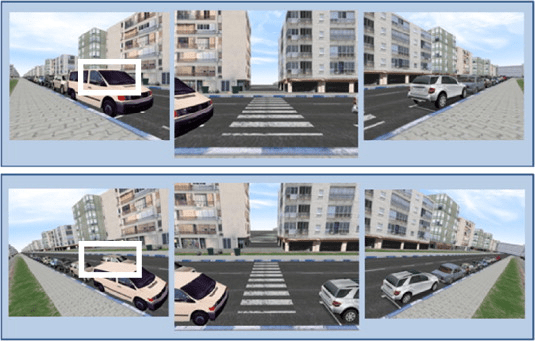
An example of an CAAHPT intervention scenario. (1) taken from a child-pedestrian’s POV (above) and (2) taken from a higher, less restricting angle (below). Note that in the dome facility, participants saw one perfect continuous image but here in the figure, the images are shown as three overlapping screens. White rectangle is given only for emphasis; not
Are child-pedestrians able to identify hazardous traffic situations?
Posted by Tal Oron-Gilad in children, hazard perception, News, pedestrians, Transportation & Safety on July 19, 2015
One more publication within the child pedestrian’s realm of road crossing co-authored by Anat Meir and Yisrael Parmet published in Safety Science, Vol. 80, pages 33-40 (2015)
Are Child pedestrians able to identify hazardous traffic situations?
Highlights
we explored child-pedestrians’ HP skills employing hazard detection task in virtual settings (our Dome lab). We used the same approach that we have used previously in the driving HP domain to study novice drivers. As pedestrians’ age increased their awareness toward potential hazards increased. 7–9-year-olds reported less instances of FOV obscured by parked vehicles. 7–9-year-olds lingered more in identifying instances of FOV obscured by parked vehicles.
Abstract
Background. Child-pedestrians are more prone to fail in identifying hazardous situations. Aiming to better understand the development of hazard-perception abilities in dynamic road situations we examined participants’ hazard detection abilities in a virtual environment.
Method. Experienced-adult participants and child-pedestrians observed typical road crossing related scenarios from a pedestrian’s point of view and engaged in a hazard detection task.
Results. Consistent with our hypotheses, less instances of obscured field of view by parked vehicles were reported as hazardous by 7–9-year-olds, who were also prone to linger more in identifying situations depicting field of view partially obscured by parked vehicles compared to all other age groups. Reports of obscured field of view by road curvature as hazardous increased with age.
Conclusions. Understanding child-pedestrians’ shortcomings in evaluating traffic situations contribute to the effort of producing intervention techniques which may increase their attentiveness toward potential hazards and lead toward reduction in their over-involvement in crashes.
-
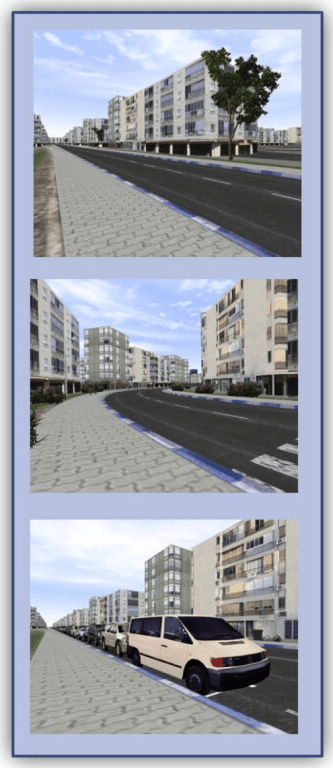
Traffic scenes for pedestrian crossing (only the left part of the scene is shown). Top: no moving elements, Mid: road curvature obscuring FOV, Bottom: Parked vehicles obscuring FOV.


