Archive for category News
The perception of pedestrians by elderly (65+) and mature (28+ with more than 10 years of driving experience) drivers
Posted by Tal Oron-Gilad in News, Transportation & Safety on January 6, 2011
This is a new publication related to hazard perception among elderly drivers. We compared HP abilities using a driving simulator and the video observation technique. As much as the simulator graphic language allowed, our simulated scenarios were replications of the observed video scenes, as shown in the examples below.
Snapshot examples of scenarios in the video observation technique

Snapshot examples of scenarios in the simultor.

To read more see:
Bromberg, S., Oron-Gilad T., Ronen, A., Borowsky, A. and Parmet Y. (in press), The perception of pedestrians from the perspective of elderly-Experienced and Experienced drivers Accident Analysis and Prevention, 2010.
http://dx.doi.org/10.1016/j.aap.2010.12.028
Abstract
We examined hazard perception (HP) abilities among elderly-experienced and experienced drivers, with regard to the presence of pedestrians in residential areas. Two evaluation methods were used; a) observation of traffic scene videos and pressing a button when a hazardous situation was identified, and b) driving in a driving simulator. The results of the video observation method showed that elderly drivers had a longer response time for hazard detection. In addition, four of the eight pedestrian-related events were difficult for elderly drivers to perceive when compared to experienced drivers. Elderly drivers, shown to have limited useful field of view, may also be limited in their ability to detect hazards, particularly when located away from the center of the screen. Results from the simulator drive showed that elderly drivers drove about 20% slower than experienced drivers, possibly being aware of their deficiencies in detecting hazards and slower responses. Authorities should be aware of these limitations and increase elderly drivers’ awareness to pedestrians by posting traffic signs or dedicated lane marks that inform them of potential upcoming hazards.
Join IEA Technical Committee (TC) on Affective Design
Posted by Tal Oron-Gilad in Affective Design, News on December 19, 2010
How to Join & Who to Contact?
Membership is FREE presently. Anyone who is interested in Affective Design may join. Complete the Registration Form, and return to the Chair/Co-Chair of the committee. Please send an email with your name, affiliation and contact information to
Dr. Halimahtun Khalid halimahtun@damai-sciences.com or Dr. Tal Oron-Gilad tal.orongilad@gmail.com
___________________________________
Why Affective Design TC?
Affective design of products and systems is a promising and dynamic field of research and application in human factors engineering, HCI, product design, computer science and engineering design. Several thematic conferences and dedicated workshops have been organized globally, such as Affective Human Factors Design (2001), Emotions and Design (2003, 2008), Emotional Design (2004), and KEER (2010). Publications on Affective Design have also appeared in journals such as Theoretical Issues in Ergonomics Science, Applied Ergonomics, and Research in Engineering Design, besides books authored by various human factors professionals, product designers, engineers, and computer scientists.
Given the growing global and multi-disciplinary interests, there is a need for the international ergonomics community to integrate the many threads of interdisciplinary issues underlying this domain, from theories, methods to application. The Affective Design Technical Committee (TC) has the goal to develop, synergize and promote the field of research and application through collaborative initiatives between researchers and practitioners.
What Objectives?
· To document and develop theories and methods in Affective Design for design purposes;
· To integrate research and practices in design of affective user interfaces;
· To participate and/or organize collaborative events for researchers and practitioners in academia and industry to share solutions;
· To publish works in the form of practical solutions for application in different domains from consumer goods to medical equipment.
How Implemented?
· Conference participation
The TC has organized special sessions at major events such as WWCS 2006, IEEM 2008, IEA 2009, KEER 2010.
Upcoming conferences:
- ODAM 2011 session will map Affective/Emotional design within the IEA Ergonomics Quality in Design (EQUID) framework.
- Call for submission has just been released for IEA 2012. We aim for substantial presence in IEA 2012 in various formats.
· Research and Application
The TC will identify niche areas for research investigation that can impact design methodologies and policies. TC members can also participate in the Ergonomics Quality in Product Design (EQUID) initiatives, in determining how affective design methodologies may be integrated into EQUID processes.
· Partnerships
The TC collaborates with the Product Design TC in organizing joint meetings, including the triennial meeting. There is a need to complement each other in research and development.
It has initiated collaborations with KEER 2010 organizers, in providing IEA support to the International Conference on Kansei Engineering and Emotion Research, www.keer2010.eu. Among the partners are Japan Society of Kansei Engineering, and Design & Emotion Society
World View and the Worldview Assessment Instrument (WAI)
Posted by Tal Oron-Gilad in Military & Law Enforcement Applications, News on December 14, 2010
“New and improved technologies may enhance the 21st Century commander’s ability to communicate with coalition partners, but coalition efforts may still founder on the shoals of technical incompatibilities, language difficulties, cultural assymetrics, and ignorance of key historical and geopolitical issues.” R.H Scales, 2001
Can Worldviews predict differences in operators’ performance under stress (OPUS) derived from cultural differences?
If proven true, WAI might be very relevant to Command and Control (C2) environments which are often characterized as “teams of teams”.
What are worldviews?
Worldviews are sets of assumptions about life and the physical and social worlds. The ‘lens’ through which one perceives reality. The central insight of Worldview is that personal and cultural assumptions about reality have profound effects upon thought and behavior. The WAI (Koltko-Rivera, 2004) has 6 Core Dimensions, and is designed to assess crucial aspects of worldview.
Table 1. Pole Reflected by Score
| Metaphysics/ontology | over 40: Spiritualist | under 40: Materialist |
| Responsibility | over 56: External | under 56: Internal |
| Agency | over 32: Voluntarist | under 32: Determinist |
| Group | over 48: Collectivist | under 48: Individualist |
| Authority | over 24: Linear | under 24: Lateral |
| Mutability | over 16: Changeable | under 16: Permanent |
What have we done?
- Translation and validation of the Hebrew version of the WAI.
- Administration of the WAI to 305 Israeli participants (150 males and 155 females) mean age 25 SD(6), 22 SD(7) respectively.
- Comparison of the results across demographic characteristics (i.e., gender, age, strength of religious believe, military service background and domain, and workplace)
- Comparison of the results to the American sample reported by Koltko-Rivera
Summary of findings
The results reflect differences between American and Israeli samples, as well as differences among the Israeli participants. Some of these differences (e.g., relation to group) were related to the type of military service that participants had experienced. Thus, worldview or its components can possible contribute to the understanding of team performance in applied settings.
Differences within Israeli sample
- Ontology – Females were significantly more spiritual than males
- Relation to group – Those who served in combat roles in the IDF were more collectivists than those who served in field jobs or administrative ones
- Relation to authority – Females were significantly more lateral than males
Differences between American and Israeli samples
- There were items in the American WAI that did not load to any factor in the Israeli one. Therefore some changes were required to be made in order to generate the Israeli scoring.
Specific differences by dimensions:
- Ontology – Israeli sample more neutral, US sample more spiritual
- Responsibility – Both samples are internal but the Israeli sample is more skewed
- Agency – Both samples are voluntarists
- Relation to group – Both samples lean toward individualism
- Relation to authority – Israeli sample more neutral, US sample more lateral
- Mutability – Both samples are neutral
A Dome Projection Platform to study Pedestrian Behavior
Posted by Tal Oron-Gilad in News, Transportation & Safety on December 8, 2010
Did you know:
- Pedestrian road crashes are amongst the most substantial causes of death, injury and long-term disability among children, particularly among those in the age range of 5-to 9 years
- Negotiating traffic requires a variety of cognitive and perceptual skills. When those skills are not properly developed, pedestrians road-related decisions will probably be inadequate
- Young children are less competent in traffic than adults
- A large proportion of traffic injuries occur while children are walking to or from school
- Elementary-school children cross the road without adults’ accompaniment, especially when coming back from school
- Prohibiting children under the age of 9 from crossing the road alone is not sufficient for reducing their over-involvement in pedestrian crashes
Towards understanding child-pedestrian’s deficits in perceiving hazards when crossing the road
Together with my colleague David Shinar and two graduate students Anat Meir and Hagai Tapiro we are in the process of developing a platform to study how children at various ages perceive hazards and dangers in the traffic environment. We have developed an experimental platform that mimics a typical Israeli urban environment.
A Dome projection facility
- Integrates the natural visual and motor skills of a person into the environment
- Large enough to have participants immersed within its circumference
- Physical movement can be added to improve simulation fidelity
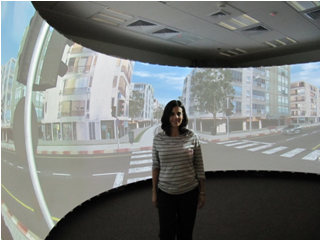
- Our dome is a 180 degrees projection facility (6.5 meters in diameter with 3-D perception projection system) it is temperature and noise controlled
- A verity of measurement (including eye tracking) and recording systems are available

Musts….
- for such a facility to be useful it must project a typical urban environment that resembles reality with the appropriate level of resolution and level of detail
- A 3-d model database of a typical Israeli urban area was developed (the database was generated by bdesign and is run on the MAK VR-Forces/VR-Vantage platform)
- Typical crossing scenarios are now being designed
So here I am proudly standing in the dome room and here’s Hagai in the control room.

Vibrotactile Guidance Cues for Target Acquisition
Posted by Tal Oron-Gilad in Military & Law Enforcement Applications, News, Tactile & Multimodal displays on December 1, 2010
This article won the Andrew P. Sage Best Transactions Paper Award for 2007
Oron-Gilad, T.; Downs, J.L.; Gilson, R.D.; Hancock, P.A.; , “Vibrotactile Guidance Cues for Target Acquisition,” Systems, Man, and Cybernetics, Part C: Applications and Reviews, IEEE Transactions on , vol.37, no.5, pp.993-1004, Sept. 2007Abstract
Three experiments examined the use of vibrotactile cues to guide an operator toward a target. Vibrotactile stimulation on the hand can provide spatially stabilizing cues for feedback of subtle changes in position. When such feedback is present, a deviation from the point of origin results in tactile stimulation indicating the direction and magnitude of the positional error. Likewise, spatial deviation from a desired position displayed tactually can provide robust position guidance and stabilization sufficient to improve the acquisition time and accuracy of fine cursor control. A major advantage of this mode of information representation is that it can be present at the same time as visual cues with minimal cross-modal interference. Our findings suggest that performance is actually enhanced when both tactile and visual cues are present. Although previous studies have suggested that various forms of tactile feedback can provide position guidance and stabilization, to our knowledge, this work is the first that details the effect of tactile feedback on target acquisition directly.
Here are some more detail about the experiments and some images:
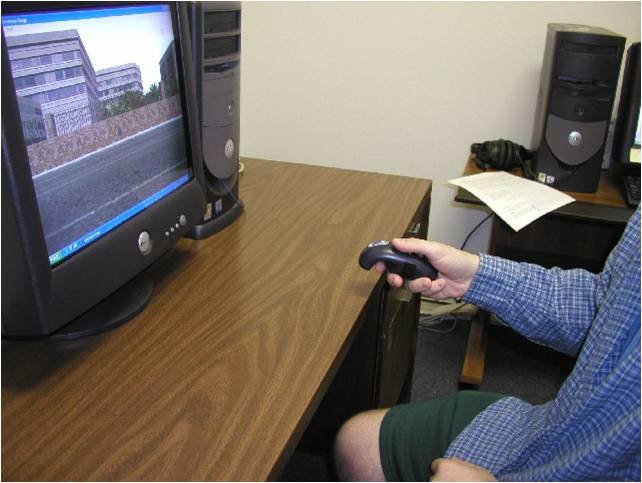 Participant's position and target arena |
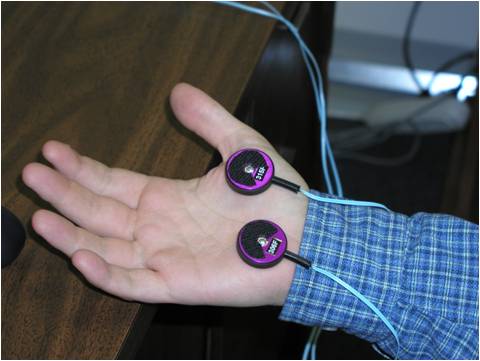 Tactors placed inside hand |
 Tactors placed outside hand |

Vibrotactile cueing continuous gradient
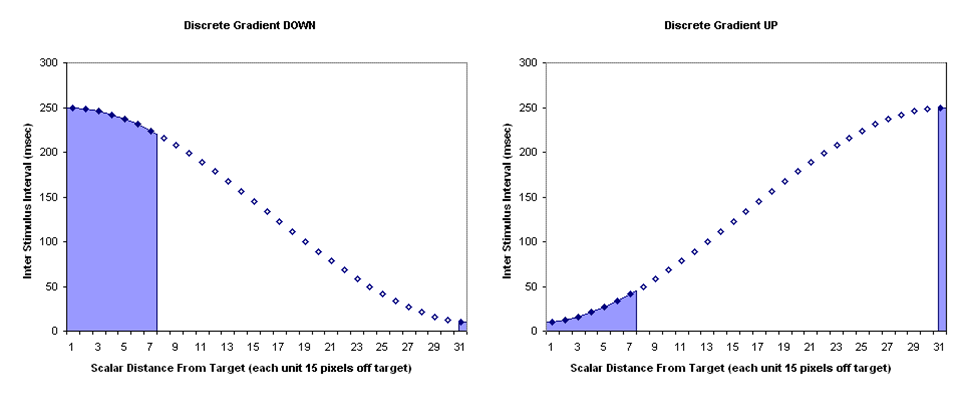
Discrete tactile gradient
-
You are currently browsing the archives for the News category.

 Human Factors Engineering