The Thermoelectric Tactile Display (TTD)
Posted by Tal Oron-Gilad in Tactile & Multimodal displays on December 29, 2010
- The Thermal Grill Illusion was first described by Thunberg (1894) and later replicated by others (Craig & Bushnell, 1994) as the sensation of paradoxical strong or painful heat elicited by touching interlaced mildly warm and cool stimuli of 20°C and 40°C respectively. Green (2002) has introduced the sensation of non-painful heat elicited by similar grill apparatus of smaller temperature range (warm 35°C-40°C and cold ≥27°C).
- Our aim is to generate thermal grill illusion (TGI) stimuli for a tactile display. The majority of tactile interfaces used today are based on vibration and pressure. No previous references shows the use of thermal displays as a stand-alone signal source, nor is there evidence of the use of the thermal grill illusion for that purpose.
- This is the first use of Thermoelectric Coolers (TEC) technology for generating a thermal grill stimuli based display. We have developed a prototype which consists of three thermal actuating units (TAU) in contact with the glabrous skin of the arm. Direct and separate computer control allows for defining the temperature and the signal duration of each of the TAUs. This architecture enables us to define the optimal characteristic for TGI signals and to explore the possibilities of tactile stimuli within the sub-modality of thermal perception.
The TAU is composed of several components yet its core is the TEC (as shown in the two images below). The TTD consists of three TAUs. In the first prototype of the TTD, each TAU was mounted on a velcro belt. In the New prototype all three TAUs are mounted on a Silicon based casing and thus wearing the display is easier. Various TGI stimuli configurations. Interlacing Hot (H) and Cold (C) Stimuli can generate various combinations.


The TTD was developed with my graduate student Yael Salzer. The second P/T was improved by the work of two wonderful students Or Ben-David and Yossi Falkovitch.
To read more see:
Thermoelectric Tactile Display Based on the Thermal Grill Illusion EuroHaptics 2008: 343-348
Thermoelectric tactile display based on the thermal grill illusion ECCE 2007: 303-304
Applications of Human Factors in Industry
Posted by Tal Oron-Gilad in Courses on December 28, 2010
This is an advanced Fourth Year Course for Industrial Engineering Student. It is an applied course which aims to provide an overview of how Human Factors and Ergonomics Design is integrated in various Industrial and Service-based domains.
List of main topics is shown below.
| Detail | Topic |
| Introduction, The history of work | 1 |
| Basic concepts in Man-Machine systems; Workload, Vigilance, SA, Automation (LOA, Function allocation, adaptive automation) | 2 |
| Designing control rooms – physical and job-related considerations | 3 |
| Designing control room interfaces; Ecological Interface Design | 4 |
| Foundations of Command & Control | 5 |
| The Dispatch domain; Design and structure of Emergency Medical Dispatch | 6 |
| Decision Support systems | 7 |
| Teleoperation, Human-robot Interaction and Human-Robot teams | 8 |
| Virtual reality, multimodal and Wearable computing | 9 |
| Navigation and Orientation issues | 10 |
Join IEA Technical Committee (TC) on Affective Design
Posted by Tal Oron-Gilad in Affective Design, News on December 19, 2010
How to Join & Who to Contact?
Membership is FREE presently. Anyone who is interested in Affective Design may join. Complete the Registration Form, and return to the Chair/Co-Chair of the committee. Please send an email with your name, affiliation and contact information to
Dr. Halimahtun Khalid halimahtun@damai-sciences.com or Dr. Tal Oron-Gilad tal.orongilad@gmail.com
___________________________________
Why Affective Design TC?
Affective design of products and systems is a promising and dynamic field of research and application in human factors engineering, HCI, product design, computer science and engineering design. Several thematic conferences and dedicated workshops have been organized globally, such as Affective Human Factors Design (2001), Emotions and Design (2003, 2008), Emotional Design (2004), and KEER (2010). Publications on Affective Design have also appeared in journals such as Theoretical Issues in Ergonomics Science, Applied Ergonomics, and Research in Engineering Design, besides books authored by various human factors professionals, product designers, engineers, and computer scientists.
Given the growing global and multi-disciplinary interests, there is a need for the international ergonomics community to integrate the many threads of interdisciplinary issues underlying this domain, from theories, methods to application. The Affective Design Technical Committee (TC) has the goal to develop, synergize and promote the field of research and application through collaborative initiatives between researchers and practitioners.
What Objectives?
· To document and develop theories and methods in Affective Design for design purposes;
· To integrate research and practices in design of affective user interfaces;
· To participate and/or organize collaborative events for researchers and practitioners in academia and industry to share solutions;
· To publish works in the form of practical solutions for application in different domains from consumer goods to medical equipment.
How Implemented?
· Conference participation
The TC has organized special sessions at major events such as WWCS 2006, IEEM 2008, IEA 2009, KEER 2010.
Upcoming conferences:
- ODAM 2011 session will map Affective/Emotional design within the IEA Ergonomics Quality in Design (EQUID) framework.
- Call for submission has just been released for IEA 2012. We aim for substantial presence in IEA 2012 in various formats.
· Research and Application
The TC will identify niche areas for research investigation that can impact design methodologies and policies. TC members can also participate in the Ergonomics Quality in Product Design (EQUID) initiatives, in determining how affective design methodologies may be integrated into EQUID processes.
· Partnerships
The TC collaborates with the Product Design TC in organizing joint meetings, including the triennial meeting. There is a need to complement each other in research and development.
It has initiated collaborations with KEER 2010 organizers, in providing IEA support to the International Conference on Kansei Engineering and Emotion Research, www.keer2010.eu. Among the partners are Japan Society of Kansei Engineering, and Design & Emotion Society
World View and the Worldview Assessment Instrument (WAI)
Posted by Tal Oron-Gilad in Military & Law Enforcement Applications, News on December 14, 2010
“New and improved technologies may enhance the 21st Century commander’s ability to communicate with coalition partners, but coalition efforts may still founder on the shoals of technical incompatibilities, language difficulties, cultural assymetrics, and ignorance of key historical and geopolitical issues.” R.H Scales, 2001
Can Worldviews predict differences in operators’ performance under stress (OPUS) derived from cultural differences?
If proven true, WAI might be very relevant to Command and Control (C2) environments which are often characterized as “teams of teams”.
What are worldviews?
Worldviews are sets of assumptions about life and the physical and social worlds. The ‘lens’ through which one perceives reality. The central insight of Worldview is that personal and cultural assumptions about reality have profound effects upon thought and behavior. The WAI (Koltko-Rivera, 2004) has 6 Core Dimensions, and is designed to assess crucial aspects of worldview.
Table 1. Pole Reflected by Score
| Metaphysics/ontology | over 40: Spiritualist | under 40: Materialist |
| Responsibility | over 56: External | under 56: Internal |
| Agency | over 32: Voluntarist | under 32: Determinist |
| Group | over 48: Collectivist | under 48: Individualist |
| Authority | over 24: Linear | under 24: Lateral |
| Mutability | over 16: Changeable | under 16: Permanent |
What have we done?
- Translation and validation of the Hebrew version of the WAI.
- Administration of the WAI to 305 Israeli participants (150 males and 155 females) mean age 25 SD(6), 22 SD(7) respectively.
- Comparison of the results across demographic characteristics (i.e., gender, age, strength of religious believe, military service background and domain, and workplace)
- Comparison of the results to the American sample reported by Koltko-Rivera
Summary of findings
The results reflect differences between American and Israeli samples, as well as differences among the Israeli participants. Some of these differences (e.g., relation to group) were related to the type of military service that participants had experienced. Thus, worldview or its components can possible contribute to the understanding of team performance in applied settings.
Differences within Israeli sample
- Ontology – Females were significantly more spiritual than males
- Relation to group – Those who served in combat roles in the IDF were more collectivists than those who served in field jobs or administrative ones
- Relation to authority – Females were significantly more lateral than males
Differences between American and Israeli samples
- There were items in the American WAI that did not load to any factor in the Israeli one. Therefore some changes were required to be made in order to generate the Israeli scoring.
Specific differences by dimensions:
- Ontology – Israeli sample more neutral, US sample more spiritual
- Responsibility – Both samples are internal but the Israeli sample is more skewed
- Agency – Both samples are voluntarists
- Relation to group – Both samples lean toward individualism
- Relation to authority – Israeli sample more neutral, US sample more lateral
- Mutability – Both samples are neutral
Act and Anticipate Hazard Perception Training – AAHPT
Posted by Tal Oron-Gilad in driving skills, Transportation & Safety on December 12, 2010
AAHPT is a research effort aimed toward developing innovative training strategies for Hazard perception among young-inexperienced drivers.
- AAHPT is still in its development stages. Nevertheless several experimental phases have already been completed
- Initial findings concerning AAHPT training methodologies are available, those are constantly embedded into future development directions.
AAHPT principles
- Intended for novice drivers who have already obtained the basic skills of driving (i.e., vehicle handling and maneuvering)
- Enriching driving experience in a short period of time (i.e., in a condensed way)
- Exposure to diverse real life driving situations (see below, residential, sparsely populated urban and inter-city areas)


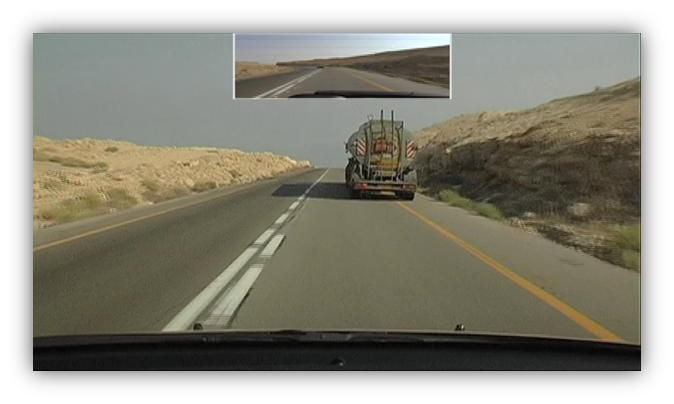
- Training- Actual hazards vs. Testing- Potential hazards (i.e., less salient situations)
- Data driven events-not are defined a priori (i.e., there is no one single master solution)
- Goal standard of experienced drivers (performance of young-inexperienced is compared to a pool of data obtained
- Variety of HP measurements
AAHPT variations
- Active – Participants observe 63 HP video-based traffic scenes and are asked to press a response button each time they detect a hazardous situation.
Participants first observe a movie press a button each time they perceive a hazardous situation. Once, completed a text box appears and they have to specify the reason for their presses.
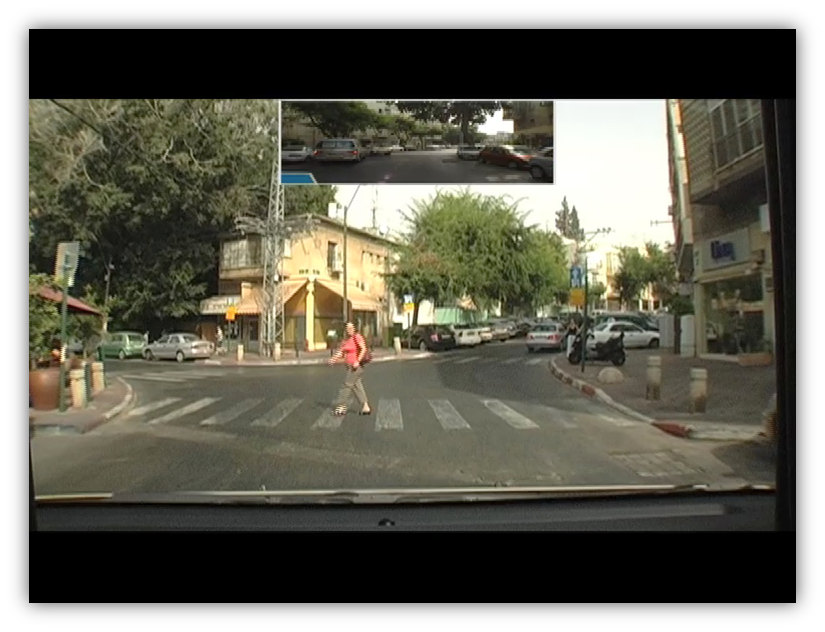
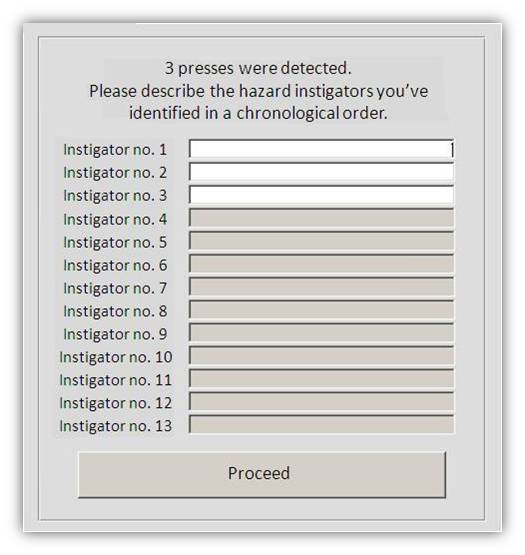
- Instructional – The ‘Instructional’ group underwent a theoretical tutorial, where written material concerning HP was followed by video-based examples. Participants were not asked to actively respond to situations, but rather to become familiar with concepts and examples.
Here are two sample slides taken from the Instructional-based training. The first leads to a discussion on different traffic environments and the second shows a specific example of pedestrians in an urban area including tips and information. This snapshot was taken from one of the 63 videos of traffic scenes used in the AAHPT training.


- Hybrid – The ‘Hybrid’ participants observed a concise theoretical component first (similar to the ‘Instructional’ mode) followed by a shortened active component (similar to the ‘Active’ mode). This mode enables the young-inexperienced drivers to receive both theoretical information as well as to act and respond.
HPT (Hazard Perception Test)
- Observe 58 HP movies and press a response button each time they detect a hazard similar way as in the Active training but different movies with less salient hazards (see following images left-training, the hazard (e.g., vehicle) is apparent whereas right-testing the hazard is not apparent ,i.e., potential danger).

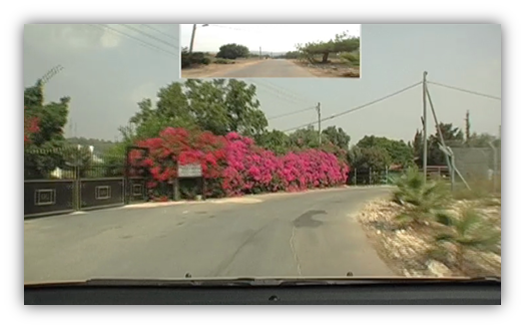
- Classification task – similar to the one used in Borowsky, Oron-Gilad and Parmet, 2009(see also www.icttp.com/presentations/pdfs/O163.pdf).
To read more:
Borowsky, A., Oron-Gilad, T., Meir A. and Parmet Y. Human Factors and Ergonomics Society’s 54th Annual Meeting. California, September 27-October 1, 2010.
Meir, Borowsky, Oron-Gilad, Parmet and Shinar. Act and Anticipate Hazard Perception Training for Young-Inexperienced Drivers, The 3rd International Conference on Applied Human Factors and Ergonomics (AHFE), July 17-20, 2010. see book chapter online http://www.crcnetbase.com/doi/abs/10.1201/EBK1439835074-c15


