Archive for category Transportation & Safety
Traffic Safety: Current Issues and Emerging Directions – conference program now available
Posted by Tal Oron-Gilad in driving skills, Transportation & Safety on September 13, 2012
Conference program is now available.
If you plan to attend don’t forget to register at the conference website http://davidshinar.eventbrite.com/ no later than September 30, 2012.
click here to download the Traffic Safety conference program
Traffic Safety: Current Issues and Emerging Directions
Posted by Tal Oron-Gilad in News, Transportation & Safety on July 25, 2012
Save the date!!!!! October 16, 2012
Traffic Safety: Current Issues and Emerging Directions
Conference in Honor of David Shinar
A conference to honor David Shinar upon his retirement will be hosted by the Department of Industrial Engineering and Management at Ben-Gurion University of the Negev (BGU) on Tuesday October 16, 2012. The conference is co-sponsored by Ben Gurion University of the Negev, Ran Naor Foundation, and the National Road Safety Authority. Leading invited scientists in the different areas spanned by David Shinar’s research will present their work in a one-day conference. A reception with David Shinar will follow the conference.
- List of speakers (in alphabetical order):
- Dr. Hillel Bar-Gera (Israel)
- Prof. ShlomoBekhor (Israel)
- Prof. Liisa Hakamies-Blomqvist (Finland)
- Prof. Shalom Hakkert (Israel)
- Prof. Ezra Hauer (Canada/Israel)
- Prof. Richard van der Horst (The Netherlands
- Prof. John D. Lee (U.S.A.)
- Dr. Tsippy Lotan (Israel)
- Dr. Tal Oron-Gilad (Israel)
- Dr. Adi Ronen (Israel)
- Prof. Dov Zihar(Israel)
- The conference organizers welcome participation by any members of the scientific and traffic safety community
- The conference and reception will be held at Ben Gurion University, Senate Building auditorium.
- Registration to the conference is free of charge. However, because space is limited attendees must register by September 30, 2012 at the conference registration website: http://davidshinar.eventbrite.com/
For additional information contact Tal Oron-Gilad at orontal@bgu.ac.il or Adi Ronen at adiro@bgu.ac.il
Child Pedestrian Crossing Study – a few updates
Posted by Tal Oron-Gilad in human factors engineering, Transportation & Safety on September 1, 2011
We have just completed this study. Analysis of results and full report are being prepared.
The objective of the research is to lay the foundations for examining whether training child-pedestrians’ HP skills while crossing a road may improve their ability to perceive potentially hazardous situations and to predict hazards prior to their materialization.
- A first step in developing a training program is to form understanding of child-pedestrians’ traffic behavior patterns. Comparing adults and children provides a depiction of what elements in the traffic environment are crucial for the road-crossing task.
- In the present study, children and adults participant in a two-phase experiment. They observe typical urban scenarios (see Figure 1) from a pedestrian’s point of view (see Figure 2) and a required to: (1) Press a response button each time they feel it is safe to cross. (2) Describe the features that they perceive as relevant for a safe road-crossing decision, i.e., the conceptual model each group of pedestrians has. Participants’ eye-movements were recorded throughout the experiment utilizing a helmet mounted tracker (Model H6-HS, Eyetrack 6000).
- To achieve this a three dimensional database of a prototypical Israeli city was built in cooperation with b.design (http://www.b-d.co.il/) , a leading provider of 3-D content. Cars, trees, billboards and various other urban elements were also designed uniquely for this environment. Using the VR-Vantage and VR-Forces different scenarios were developed to examine crossing behavior at various conditions.
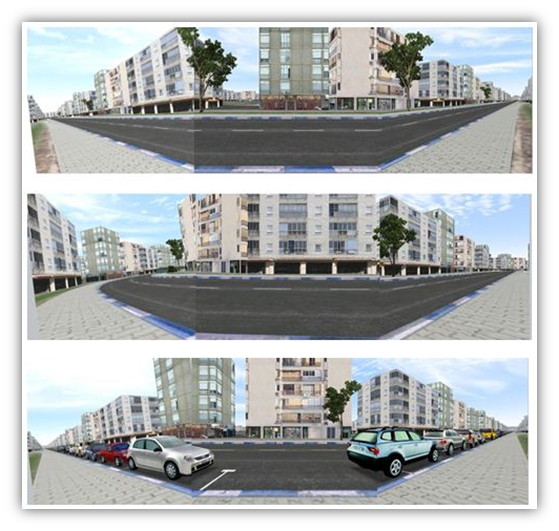
Figure 1. The generic city simulated environment presented in the Dome setting (it looks a bit awkward here because its intended to be projected on a dome screen). The Field of View is: (1) Unrestricted (above); (2) Partially obscured by the road’s curvature (middle); (3) Partially obscured by parked vehicles (below).
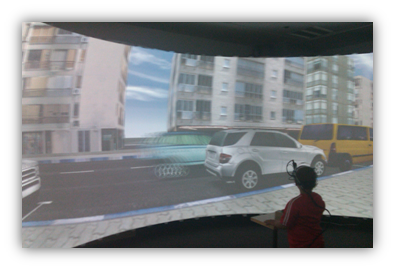
Figure 2. Simulated environment from a child-pedestrian’s point of view.
Perceptions of electronic navigation displays
Posted by Tal Oron-Gilad in Affective Design, in-vehicle, Transportation & Safety on August 15, 2011
Electronic navigation maps
- support drivers when travelling within unfamiliar areas
- need to support several tasks; visual search, location assessment, and complex integrative route planning
- are used while driving, when drivers should not take more than quick glances at them, it is essential that they do not impair driving safety.
- will become a necessity in future vehicle configurations, i.e., as vehicles become more semi-autonomous and drivers changre from active operators of the vehicle to passive monitors
The study
- examined different display formats to better support usability and aesthetic requirements.
- aimed to validate the results found by Lavie, Oron-Gilad and Meyer (2010).
- further examine additional design attributes – focusing on:
- graphic style
- landmarks and how landmarks affect aesthetic perceptions
- rural and urban road maps
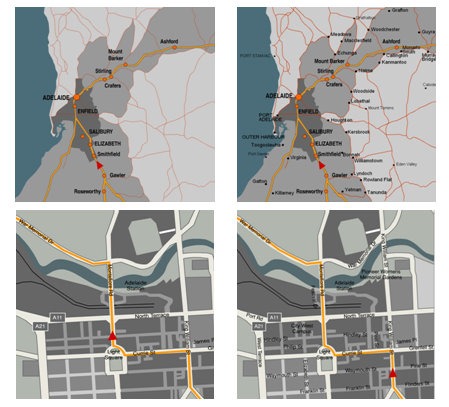
Figure 1. Examples of maps in a ‘Traditional elegant monochromatic’ graphic style, with more (right maps) and less (left maps) information for the rural (upper row) and urban (bottom row) settings.
Experiment 2 further examined maps with non-aesthetic graphic styles to see how that affects usability perception and actual use.

Figure 1. Examples of maps. Right: a ‘Realistic green’ graphic style, Left: an illustration of an ‘arbitrary’ color arrangement, i.e., the color coded areas do not correspond with the driver’s route.
To read more, look for:
Talia Lavie and Tal Oron-Gilad, Perception of navigation displays, to appear in Behaviour & Information Technology
Abstract
This study evaluated aesthetics and usability of in-vehicle electronic navigation maps. Experiment 1 examined map displays that varied in the amount of information presented, abstraction level, graphic/color style, and the existence of landmarks in both urban and rural environments using objective and subjective measures. Twenty participants performed navigation/localization tasks using avrious map configurations while driving a driving simulator and completed usability and aesthetic questionnaires. The minimal detail map produced better performances and higher usability and aesthetic ratings when using maps with no landmarks. Adding information in the form of landmarks was found advantageous compared to additional textual information. Abstractions were most advantageous when combined with minimal amount of detail. Moderate abstractions were sufficient for obtaining the desired benefits when more details were present. The graphic/color style affected subjective perceptions. Overall, high correlations were found for the perceived aesthetics and usability scales, however, low correlations were found between actual usability (i.e., performance) and perceived usability pointing to the importance of using both objective and subjective usability measures. Experiment 2 examined how maps varying in their aesthetic level (aesthetic versus non-aesthetic), different color arrangements, and 2D versus 3D landmarks affect subjective and objective measures. Participants distinguished between usability and aesthetic perceptions and usability perceptions were less affected by aesthetics when the aesthetic level of the maps was low. Color arrangement did not affect the measures examined. Both 2D and 3D landmarks were found to be aesthetic and usable. We conclude this paper with guidelines for designing in-vehicle navigation map displays.
Child Pedestrian Crossing Study – Trailer
Posted by Tal Oron-Gilad in Transportation & Safety on May 1, 2011
- Pedestrian road crashes cause death, injury and disability among children. Five to nine year old children endure ~four times the injury rate of adults, in spite of their lower exposure to traffic.
- Practical training can lead to improvements in children’s crossing skills, e.g., the ability to make roadside timing judgments (Demetre et al., 1992), plan safe routes (Thomson et al., 1992) and cross safely at junctions (Rothengatter, 1984).
A first step in developing a training program is to form understanding of children traffic behavior patterns, e.g., when and where do children cross? What are they looking out for before crossing? etc.
Comparing adults and children provides a depiction of what elements in the traffic environment are crucial for the road crossing task.
- In the present study, children and adults participate in a two-phase experiment. They observe typical urban scenarios from the point of view of pedestrians and are asked to:
- Describe the features that they perceive as relevant for crossing the road safely, i.e., the conceptual model each group has.
- Press a button or ‘step off a curb’ each time they think it is safe to cross.
- Eye movements are recorded using a helmet mounted tracker, as shown in the Trailer.
References
Demetre, J.D. & S. Gaffin, S. (1994). The salience of occluding vehicles to child pedestrians, British Journal of Educational Psychology, 64, 243–251.
Rothengatter, J.A. (1984). A behavioral approach to improving traffic behaviour of young children. Ergonomics 27 (1984), pp. 147–160.
Thomson, J.A., Tolmie, A., Foot, H.C. & McLaren, B. (1996). Child Development and the Aims of Road Safety Education. Road Safety Research Report No. 1. London: HMSO.
-
You are currently browsing the archives for the Transportation & Safety category.

 Human Factors Engineering